Tag Archives: nanotechnology

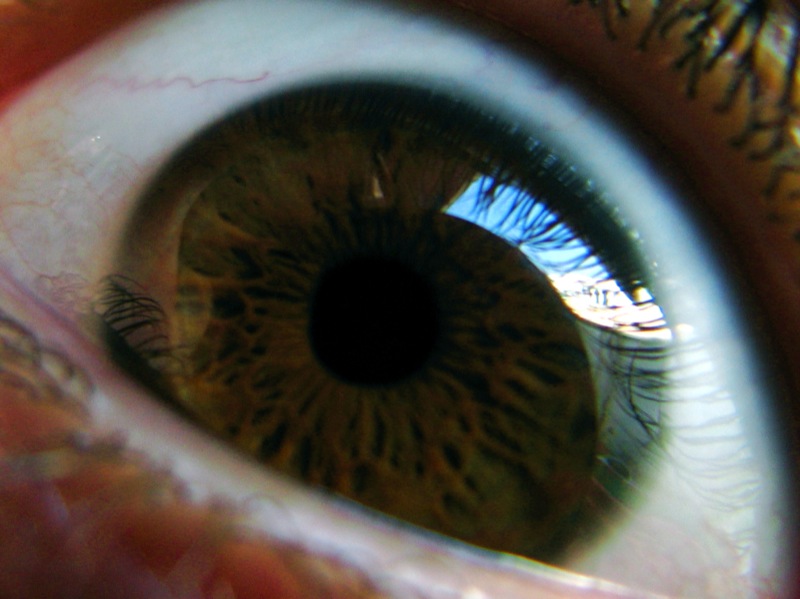
Photovoltaic Polymer Lets Damaged Retinas See the Light

Italian Institute of Technology Researchers Use Photovoltaic Polymer to Restore Light Detection to Damaged Retinas

A team of neuroscientists and materials scientists has shown that a photovoltaic polymer can restore light-sensing capabilities to damaged retinas, offering hope of a simple way to restore vision to many people with degenerative eye disease.

One day…

Related article:
http://www.technologyreview.com/news/512511/photovoltaic-polymer-lets-damaged-retinas-see-the-light/

Bionic eyes become a reality

Today while I was giving a glance on Engadget, I have find an interesting article: “Bionic lens to debut in the next half-decade

I have always thought since my childhood that having bionic eyes is pretty intriguing. Any one who have watched 6 million Dollar man would probably think alike.

Dante Cesa of Engadget, the author of the mentioned article that according to Professor James Wolffsohn from Aston University in the United Kingdom imagines that within the next decade, the cure to near- and farsightedness will not only exist, but will actually be within reach. Beyond the concept what makes that this is possible is because they are also working with some opthology companies to commercialize the whole concept.

Without any doubt this is a good news with people with eye problems and for blind people. The possibility of combining the bionic lenses/eyes with other type of computer technologies would also make a great contribution and would yield to new advances for people with eye-problems or for professionals like doctors, pilots who might receive additional information about what they see. The potential is endless and advances in nanotechnology and nanoscale fabrication techniques would make possible the creation of these kind of advanced bionic eyes.

Bionic eyed modern Cyclops would replace all concepts previously appeared on comics or movies like Terminator, Bionic Woman

Some articles related with this issue that I can suggest are:

And some written/visual products related with the issue:

eye

Lithium Ion batteries 10 times longer with nanotechnology

While reading gas2.org I found out about a research held at Stanford University that made it possible increasing the capacity of lithium-ion batteries by 10 through usage of silicon nanowires.

Yi Cui, who was the head of the research team says: “Given the mature infrastructure behind silicon, this new technology can be pushed to real life quickly.

This is good news. Lithium-ion batteries are used widely nowadays and such a boost in their capacity due to nanotechnological achievements would probably help arise of lots of applications in different fields like energy storage, mobile device batteries, electric-powered automobiles etc.

They managed to increase the capacity of batteries by storing lithium inside tiny silicon nanowires. As they soak up, lithium nanowires inflate four times their normal size but unlike other shapes, they don’t fracture.

You can have a more detailed read:

Productive Nano Systems: The future of manufacturing, the next industrial revolution

Nanotechnology, undoubtedly, is the next big thing in the course of human civilization.

A big change is coming, and it may (will) affect everything. The way we produce objects, the way we process materials, the whole economic system.

Nanotechnology can basically be defined as “building by atoms”. And if you wonder how is this possible, I strongly suggest that you have a look at this animated video. A mind blowing visualisation of a production facility of tomorrow (not 100 years, but 10 to 20 years from now), and opening new horizons.

Are we ready? 😉

http://www.youtube.com/watch?v=vEYN18d7gHg

More posts to come about this topic..

Dragut

World’s smallest book thanks to nanotechnology

Dragut, who is cowriter of this blog sent me a few links related with nanotechnology during the week. It seems that we will go on publishing interesting news and information about nanotechnology and its applications to product design field.

The one you will read now is rather a scientific challenge in order to force the limits of this technology: According to what is published in nanowerk.com, publisher Robert Chaplin and the scientists at the Nano Imaging Facility of Simon Fraser University created the world’s first nano-scale book.

The book even has an ISBN Book Number and if you have an electron microscope you would be able to read it: it is sized 0.07 mm X 0.10 mm. 🙂

The production of the nanoscale book was carried out at SFU by publisher Robert Chaplin, with the help of SFU scientists Li Yang and Karen Kavanagh. The work involved using a focused-gallium-ion beam and one of a number of electron microscopes available in SFU’s nano imaging facility.

With a minimum diameter of seven nanometers (a nanometer is about 10 atoms in size) the beam was programmed to carve the space surrounding each letter of the book.

The book is made up of 30 microtablets, each carved on a polished piece of single crystalline silicon, and has its own International Standard Book Number, ISBN-978-1-894897-17-4.

Growing Renewable Energy Markets and Trends

This recent report published by helmut kaiser consultancy is an interesting lecture in order to get an idea of how the global renewable energy market would evolve during the next decade.

Increasing demand thanks to social and political awareness and decreasing prices are yielding the renewable energy as a really interesting option especially for the developing countries. Advances in fields like nanotechnology, which should help the storage and efficient use of the energy, are also expected to boost use of renewable energy sources.

Abstract:
The energy mix will be more regenerative and sustainable. The market volume of renewable energy worldwide will increase from US$ 95.8 billion in 2007 to US$ 124.4 billion in 2010 and reach US$ 198.1 billion in 2015.

Nanotechnology Now – Press Release: “New Study:Renewable Energy Markets Worldwide 2015 driven by Climate Change with high increase.”

The energy mix of the future will be more regenerative and sustainable. The generation and storage of renewable energy will be the fastest growing sector in energy market for next 20 years…

A Cheaper New Technology for Solar Power

As I usually do, I will say the last thing first, because this one is really striking:

“The energy that reaches earth from sunlight in one hour is more than that used by all human activities in one year”

Wow, I didn’t know that! And they call them ‘high-tech’, all those internal combustion engine cars, turbo diesels, and even hybrids.. It’s all the same crap!

For those who are expecting to see the days finally this abundant source of energy will be widely used on earth, I have good news!

Massey University’s Nanomaterials Research Centre is presenting a newly developed technology that will have cheaper initial costs for solar electric power production, making it more accessible to home owners.

Although it still is in the development phase, the technology is inspired by plants, and it is promising to be 10 times cheaper and much more effective than silicon based photo-electric solar cells.

Dr Wayne Campbell and researchers in the centre have developed a range of coloured dyes for use in dye-sensitised solar cells. The green dye uses a synthetic chlorophyll, a derivative of the light-harvesting pigment plants use for photosynthesis.

Besides being cheaper, I believe that this dye-based technology has another major advantage: It has colour! So instead of the 80’s shiny solar panel looks dictated by the old technology, this one lets people free to choose colour, not only among shades of green, but also other tones too, although the non-greens being based on haemoglobin, the compound that give blood its colour (ahem!)…

Hopefully in our lifetime, instead of paying heating and electricity bills or filling the tanks of our vehicles with petrol, we will be able to use a “really-high-technology” in our autonomous houses that will enable us to use more efficiently the free energy offered by the sun, or travel in our electric powered super-silent vehicles in peace, as far as we desire, without killing each other -and ourselves- with the toxic fumes coming out of the exhausts, and the fear of running out of gas.

For further information, please visit the Massey University website:

http://masseynews.massey.ac.nz/2007/Press_Releases/04-04-07.html